
Retrieval-Augmented Generation (RAG)
Large language models are remarkably fluent but they're also frozen in time and prone to confidently making things up. Ask a plain LLM about your company's internal refund policy, and it will either say "I don't know" or, worse, invent a plausible-sounding answer. Retrieval-Augmented Generation (RAG) solves this by giving the model a way to look things up before it answers, instead of relying purely on what it memorized during training.
This article walks through what RAG is, how it works under the hood, why it matters, and the practical challenges you'll run into when building one.
What Is RAG, Really?
At its core, RAG is a simple idea: retrieve relevant information first, then generate an answer using that information as context.
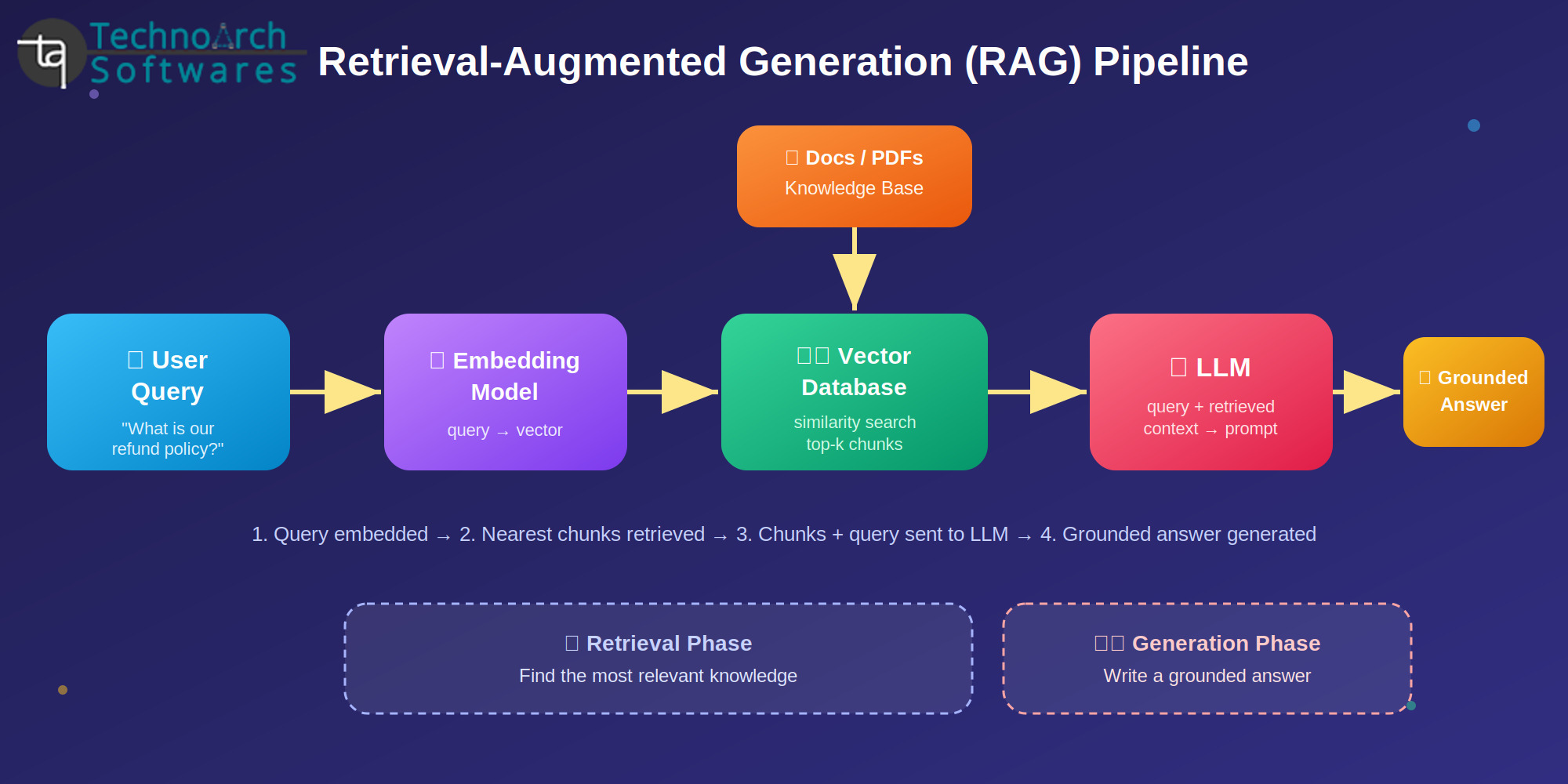
Instead of asking an LLM to answer purely from its training data, a RAG system:
1. Takes the user's question
2. Searches an external knowledge base for the most relevant pieces of information
3. Inserts those pieces into the prompt alongside the question
4. Lets the LLM generate an answer grounded in that retrieved content
The result is a model that can cite specifics, stay current with fresh data, and reduce hallucination — without needing to be retrained every time the underlying knowledge changes.
How the Pipeline Works
1. Indexing (done ahead of time)
Before any question is asked, your documents — PDFs, wikis, support tickets, product docs — are broken into smaller chunks (usually a few hundred words each) and converted into embeddings: numerical vectors that capture semantic meaning. These vectors are stored in a vector database (like Pinecone, Weaviate, Chroma, or pgvector).
2. Retrieval (happens at query time)
When a user asks a question, that question is also converted into an embedding. The system then performs a similarity search against the vector database to find the chunks whose meaning is closest to the question — not just chunks that share the same keywords, but ones that are conceptually related.
3. Augmentation
The top-matching chunks are inserted into the prompt sent to the LLM, typically structured like:
Context:
[retrieved chunk 1]
[retrieved chunk 2]
[retrieved chunk 3]
Question: What is our refund policy?
Answer using only the context above.
4. Generation
The LLM reads the question and the supplied context, then produces an answer. Because the answer is grounded in retrieved text, it can reference specifics — dates, numbers, exact policy language — that the model never saw during training.
Why RAG Matters
- Reduces hallucination. The model has real source material to draw from instead of guessing.
- Keeps knowledge current. Update the knowledge base, and the system's answers update instantly — no retraining required.
- Enables source attribution. Because you know exactly which chunks were retrieved, you can show users where an answer came from.
- Is far cheaper than fine-tuning. Fine-tuning a model on private data is expensive and has to be repeated every time the data changes. RAG just needs new documents indexed.
- Keeps sensitive data out of model weights. Private information stays in your database rather than being baked into a model.
Common Design Challenges
RAG sounds simple in theory, but production systems run into real engineering problems:
Chunking strategy. Split documents too small, and you lose context. Split them too large, and irrelevant text dilutes the retrieval. Most teams tune chunk size, overlap, and boundaries (e.g., splitting on headings rather than arbitrary character counts) specifically for their data.
Retrieval quality. Pure vector similarity search can miss exact keyword matches (like product SKUs or legal clause numbers). Many systems now use hybrid search , combining vector similarity with traditional keyword search (BM25) and a re-ranking step to reorder retrieved chunks by true relevance before they hit the LLM.
Context window limits. You can only fit so many chunks into a prompt. Retrieving too much wastes tokens and can bury the useful information; retrieving too little means the model lacks what it needs.
Freshness and sync. Someone has to keep the vector database updated as source documents change, get deleted, or get added — this is a real data-engineering pipeline, not a one-time setup.
Evaluation. How do you know if the system's answers are actually good? Teams typically track retrieval metrics (did we retrieve the right chunk at all?) separately from generation metrics (did the model use it well?).
A Simple Mental Model
Think of a plain LLM as a brilliant person answering entirely from memory, and RAG as that same person allowed to open a relevant textbook to the right page before answering. The reasoning ability doesn't change — but the accuracy and trustworthiness of the answer goes up dramatically, because the "open book" is your own curated, current, and (hopefully) correct information.
Closing Thoughts
RAG has become one of the default architectures for building practical, trustworthy LLM applications — chatbots that answer from internal documentation, customer support tools, coding assistants that search a codebase, and research tools that cite their sources. It isn't the only way to inject knowledge into a model (fine-tuning and long-context prompting are alternatives), but for most real-world, frequently-changing knowledge bases, RAG remains the simplest and most cost-effective place to start.
If you're building your first RAG system, start small: pick a clean, well-scoped set of documents, use a straightforward chunking strategy, and get a basic retrieval-plus-generation loop working end to end before optimizing any single piece.
0 Comments:
Leave a Comments